

On Wednesday, August 12, 2026, an extremely rare astronomical event will captivate millions of eyes in Europe: a total solar eclipse. The last one was on August 11, 1999. The next one visible from France will not happen until 2081. Suffice to say, this is an event not to be missed, provided, of course, that you protect your eyes.
Because observing the Sun without proper glasses, even for a few seconds, can cause irreversible damage to the retina. This guide tells you everything you need to know before August 12.
An exceptional astronomical phenomenon
A total eclipse occurs when the Moon passes exactly between the Earth and the Sun, completely obscuring the solar disk. The sky darkens in broad daylight, stars become visible, and the temperature drops. And above all, the solar corona, the Sun's outer atmosphere, normally invisible, is revealed in all its splendor.
The path of totality, about 200 km wide, crosses the Arctic, descends over the Iberian Peninsula, skirts the Balearic Islands, and crosses the Maghreb. The best European spots are located in northern Spain, Asturias, Cantabria, Galicia, where totality will last about 2 minutes.
The next total eclipse visible from mainland France will not be until 2081: it's now or never.
The eclipse viewed from France: times city by city
From mainland France, totality is not accessible. But the rest of Western Europe will experience a very pronounced partial eclipse, with over 80% coverage over a large part of French territory. The darkening will be very noticeable, with a twilight-like ambiance.
An important point to remember: the Sun will be low on the horizon at the time of maximum, around 15 to 20 degrees in height. A clear horizon to the west-southwest therefore becomes absolutely crucial for observation from France.
Here are the times for the main French cities (source: SODAP-SOBOMEX / Sky & Space):
| City | Maximum | Obscuration | Start | End |
|---|---|---|---|---|
| Toulouse | 8:26 PM | 97.9 % | 7:31 PM | 9:02 PM |
| Bordeaux | 8:24 PM | 97.6 % | 7:29 PM | 9:13 PM |
| Montpellier | 8:25 PM | 96.8 % | 7:31 PM | 8:52 PM |
| Marseille | 8:25 PM | 96.4 % | 7:31 PM | 8:46 PM |
| Nîmes | 8:24 PM | 96.2 % | 7:30 PM | 8:51 PM |
| Toulon | 8:25 PM | 96.3 % | 7:31 PM | 8:43 PM |
| Nantes | 8:20 PM | 95.8 % | 7:24 PM | 9:13 PM |
| Rennes | 8:19 PM | 95.2 % | 7:23 PM | 9:12 PM |
| Nice | 8:24 PM | 95.1 % | 7:30 PM | 8:39 PM |
| Lyon | 8:21 PM | 93.8 % | 7:27 PM | 8:53 PM |
| Angers | 8:20 PM | 94.9 % | 7:24 PM | 9:12 PM |
| Grenoble | 8:22 PM | 94.1 % | 7:28 PM | 8:48 PM |
| Paris | 8:17 PM | 92.1 % | 7:22 PM | 9:09 PM |
| Le Havre | 8:16 PM | 92.8 % | 7:20 PM | 9:09 PM |
| Dijon | 8:19 PM | 92.2 % | 7:24 PM | 8:56 PM |
| Strasbourg | 8:16 PM | 89.9 % | 7:22 PM | 8:49 PM |
⏱ Times are indicated in local time (CEST). Plan to set up a little before the start time, with a clear horizon to the west.
Why protecting your eyes is absolutely essential
Observing an eclipse is one of the rare occasions when millions of people look directly at the Sun. And that's where the danger lies.
The real risks of unprotected observation
Solar radiation, UV, infrared, and intense visible light, burns the retina silently and irreversibly. There is no pain at the time. Symptoms appear several hours later: blurred vision, a central dark spot, partial loss of sight. This retinal burn, called solar retinopathy, is permanent.
The following are absolutely ineffective and dangerous for observing the Sun:
- Ordinary sunglasses, even very tinted ones
- Non-approved photographic filters
- Film, CDs, smoked glass, or unsuitable welding glass
Only glasses specifically designed for solar observation, meeting a certified standard, offer real protection.
The EN ISO 12312-2 standard: the only guarantee of safety
To observe the Sun, during an eclipse or at any other time, only one standard is relevant: European standard EN ISO 12312-2:2015. It defines the minimum filtration requirements for solar filters for direct eye use.
How to recognize reliable glasses?
Certified eclipse glasses must bear:
- The CE (Conformité Européenne) marking
- The explicit mention of standard EN ISO 12312-2:2015
- The name and contact details of the manufacturer or European importer
Beware of cheap glasses sold without a standard indication, especially in markets or uncontrolled platforms as the event approaches. Certified CE / ISO 12312-2 glasses may be hard to find as August 12, 2026 approaches: it's best to secure yours now.
Certified eclipse glasses, from €4.90
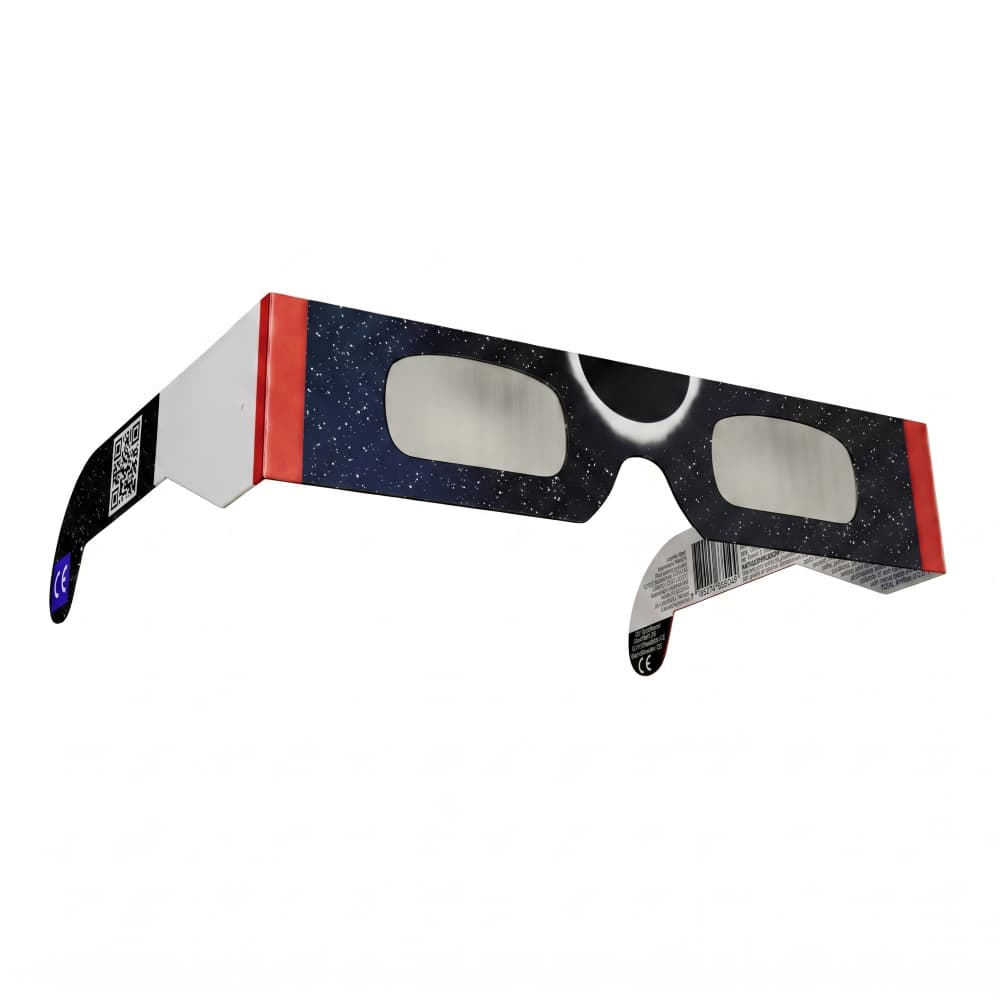
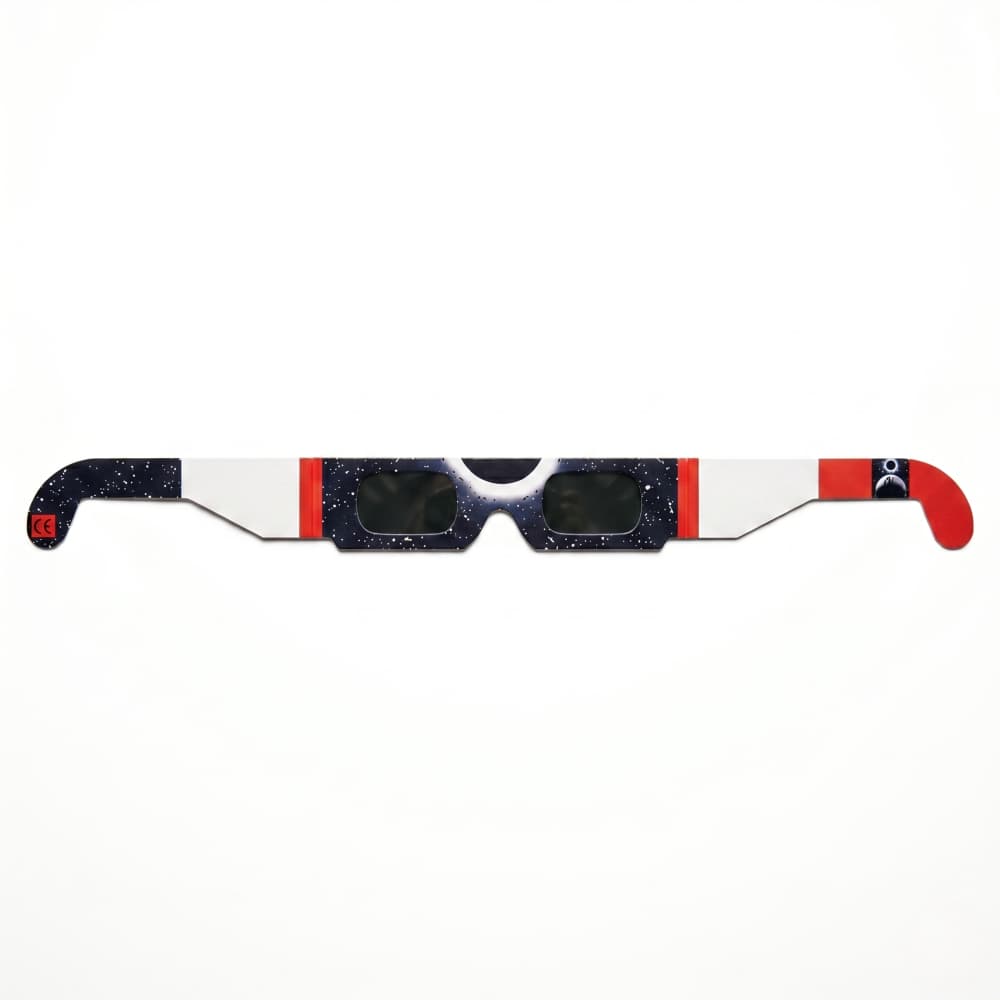
On varionet.com, you will find CE certified solar eclipse glasses, compliant with standard EN ISO 12312-2:2015, starting from €4.90.
These glasses are manufactured by Sky & Space (SODAP-SOBOMEX), a recognized specialist for many years in the manufacture of solar filters for public astronomy. They have an EU type-examination certificate issued by DIN CERTCO (TÜV Rheinland), notified body no. 0196, under reference C7666SSO/R0, valid until 2031.
We offer the model:
Their silver-grey mirrored PET lenses, 0.1 mm thick, effectively filter UV, infrared radiation, and visible light, for safe observation, with family, with children, to add if necessary over your own glasses.
In summary
On August 12, 2026, France will experience an exceptional celestial spectacle. With obscuration reaching up to 97.9% depending on the city, the event will be impressive even without traveling to Spain. But to enjoy it with wide-open, healthy eyes, only one rule applies: certified glasses, and only certified glasses.
This is a good time to take care of your visual health: a great opportunity to remind your loved ones that eyes are irreplaceable.
Also read on the Varionet blog
- Summer is here: how to properly protect your eyes from the sun?
- How to protect your eyes and vision during a heatwave
- How to choose your sunglasses properly
Sources: SODAP-SOBOMEX / Sky & Space - DIN CERTCO, certificate C7666SSO/R0 - Société Astronomique de France - generationvoyage.fr - sciencepost.fr